The century that learned to stop asking.
The scandal is not that quantum mechanics is difficult. The scandal is how often difficulty was converted into doctrine: no mechanism, no deeper variables, no ordinary reality—and eventually, no embarrassment about saying so.
1. The impossibility proof that was not impossible enough
Von Neumann’s 1932 mathematical authority helped harden the idea that hidden-variable completions were impossible. Kay traces the historical wreckage: Grete Hermann attacked the circularity in the 1930s; later Bell showed that the crucial assumptions were not necessities of thought. The “proof” had ruled out what it had effectively assumed away.
This matters because impossibility theorems do cultural work long after their assumptions have been forgotten. Once a result becomes folklore, the theorem’s domain quietly expands in retelling. A restriction on one mathematical class turns into a prohibition on deeper reality itself.
2. Bohm committed the unforgivable act: he wrote down the “impossible.”
In 1952 David Bohm produced an explicit deterministic completion of nonrelativistic quantum mechanics. Whatever one thinks of pilot-wave theory, its mere existence demolished the lazy claim that no deeper deterministic model could even be formulated.
Kay highlights the reaction because it is devastating to the mythology of serene, purely evidential progress. Oppenheimer’s reported response was essentially: if Bohm cannot be disproved, ignore him. Bell later described encountering Bohm’s construction as seeing the supposedly impossible done.
3. The “nobody understands it” boast should have caused panic.
Quantum culture turned conceptual opacity into a rite of passage. Feynman’s famous admission that nobody understands quantum mechanics became charming folklore rather than an indictment. Kay’s point bites because it is so simple: in almost any other mature physical theory, “nobody understands what this means” would be a research emergency.
Here it became sophistication. Students learned that wanting a causal picture was naïve, that asking what the wavefunction physically represented was dangerous, and that the double-slit mystery was not a temporary gap but something one should learn to admire.
4. Measurement was given a magic border crossing.
The standard formalism contains smooth unitary evolution and a separate measurement update. That split is not cured by giving the apparatus a dignified name. What exactly counts as measurement? Where is the physical threshold? Why should one interaction be described by one law and another by a different update?
The interpretive ecosystem exists because those questions did not disappear. Copenhagen obscures the border. Many-worlds abolishes collapse by multiplying branches. Objective-collapse theories add new dynamics. Bohm adds configuration. QBist and relational approaches relocate meaning. This is not one ontology triumphantly read from experiment. It is an unresolved metaphysical bidding war around shared mathematics.
5. Bell became the new all-purpose stop sign.
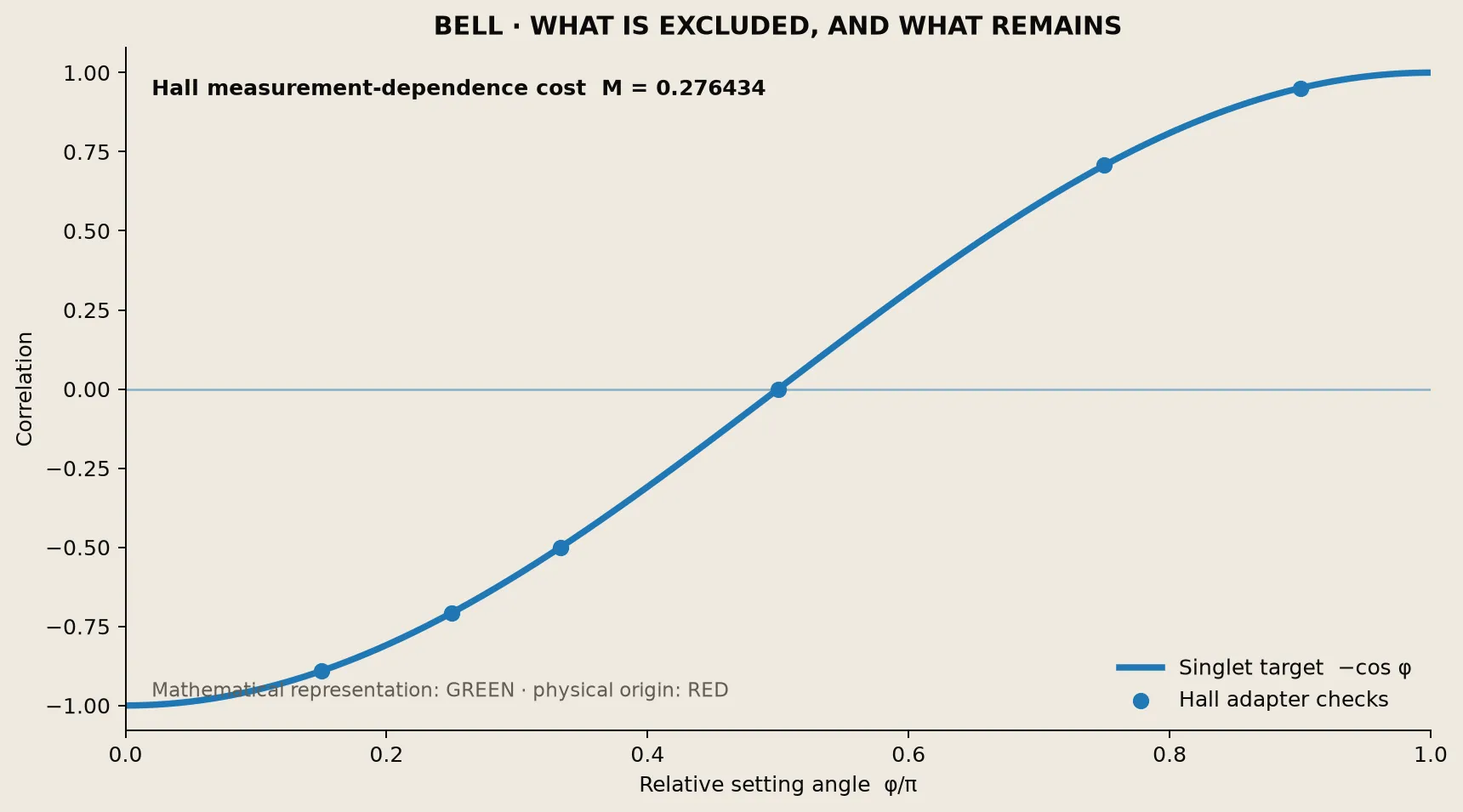
Bell’s theorem is profound precisely because it is conditional and exact. But popular retellings often mutilate it into slogans: “local realism is dead,” “reality is nonlocal,” or simply “classical physics is impossible.” The theorem deserves better.
Our own Hall adapter is a useful antidote. Relax measurement independence and one can reproduce singlet correlations with deterministic local response functions while retaining no-signalling marginals. That does not provide the physical mechanism. It does prove that the slogan is broader than the theorem.
6. Quantum vocabulary became self-certifying.
Once an effect is baptized “quantum tunneling,” “quantum vacuum fluctuation,” “quantum jump,” or “quantum correlation,” alternative mechanisms are forced to argue against the noun before they reach the data. That is rhetoric disguised as taxonomy.
This project strips the adjectives off. We ask what crossed the barrier, what correlation was measured, what spectrum was observed, what detector fired. Only after mechanism comparison does an ontological label earn its keep.
7. The interpretive chaos is not a footnote. It is the crime scene.
A mature ontology should not require mutually incompatible accounts of whether the wavefunction is real, whether worlds split, whether outcomes are created by measurement, whether probabilities are personal beliefs, or whether particles have trajectories. The lack of agreement does not invalidate the predictive algorithm. It does invalidate swagger about having uniquely discovered what reality is.
8. Classical Reconstruction reopens the case.
We do not restore nineteenth-century physics. We restore the explanatory demand: explicit variables, explicit dynamics, explicit detector interactions, explicit boundary conditions, and explicit failure tests. If objective field models fail, publish the corpse. If they survive, stop calling them impossible.
The standard is deliberately merciless. A pretty analogy gets nothing. A scalar fit gets little. Transfer, full statistics, stable dynamics and novel prediction earn progressively more. This is how a polemic graduates into a replacement program rather than another interpretation club.
Quantum mechanics gets to keep every prediction it earned. It does not get to keep every metaphysical conclusion people stapled to those predictions afterward.
Source note
This dossier is grounded primarily in Adam Forrest Kay, Escape from Shadow Physics (Basic Books, 2024), including his discussions of Grete Hermann, von Neumann, Bohm, Bell, Copenhagen-Göttingen orthodoxy, positivism and the culture of explanatory surrender. The rhetoric and synthesis here are ours.